How Much Does Google Ads Cost in California for Businesses
Introduction
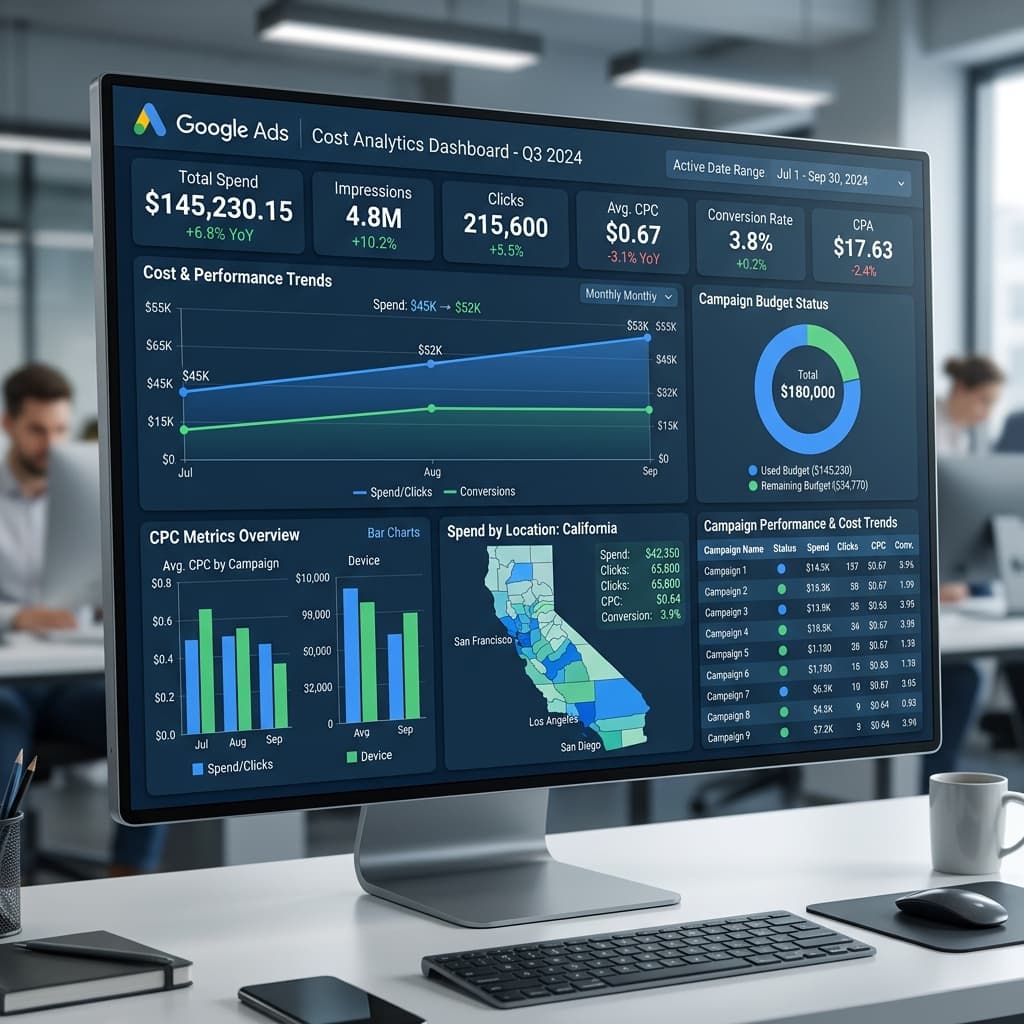
One of the most common questions businesses ask when starting their digital marketing journey is: “How much does Google Ads cost in California?”
The answer is rarely a simple number. Costs vary significantly based on your industry, the specific keywords you target, the level of competition in your area, and the effectiveness of your overall campaign strategy. California is home to some of the most competitive advertising markets in the world, which means that the cost-per-click (CPC) can be substantially higher than in other regions.
However, a high cost does not necessarily mean poor performance. When managed correctly, Google Ads can provide a predictable and scalable source of high-quality leads. Understanding how pricing works is the first step toward controlling your budget and maximizing your return on investment (ROI).
If you are new to the world of paid advertising, we recommend starting with our foundational guide on
Google Ads strategy for maximizing ROI in California
Why Google Ads Costs More in California
California is a unique market. From the tech hubs of Silicon Valley to the sprawling industries of Los Angeles and San Diego, the state is packed with businesses vying for the top spot on Google.
Key Factors Driving California Ad Costs
- Saturated Markets: A higher density of advertisers means more competition in the auction, which naturally drives up bids.
- High-Value Industries: Industries such as legal services, healthcare, and real estate have massive lifetime customer values, leading businesses to bid aggressively.
- Massive Search Volume: The sheer population of California creates high search demand, but also a high volume of potentially low-intent clicks if targeting isn't precise.
- Sophisticated Competition: Many California businesses work with top-tier agencies, meaning you are competing against some of the best-optimized campaigns in the country.
These factors make it essential to have a data-driven approach. Without it, you are likely to overpay for traffic that doesn't convert.
Average Google Ads Cost in California
To plan your budget effectively, you need to understand the benchmarks for your industry. While these numbers change daily, they provide a good starting point for your projections.
Cost Per Click (CPC) Benchmarks
- Low Competition (e.g., Local Niche Services): $1 – $3 per click.
- Medium Competition (e.g., General Professional Services): $3 – $10 per click.
- High Competition (e.g., Personal Injury Law, Specialized Medical): $10 – $50+ per click.
Typical Monthly Budgets
- Small Local Businesses: Often start with $1,000 – $3,000 per month to gain initial traction.
- Medium-Sized Enterprises: Typically allocate $3,000 – $10,000 per month to maintain a dominant presence.
- Large Corporations & High-Growth Startups: Often spend $10,000+ per month to scale across multiple regions.
Factors That Affect Your Specific Google Ads Cost
Your cost is not just determined by what others are bidding. Google uses a complex formula to decide how much you pay.
1. Industry Competition
The more profitable a lead is for your industry, the more you can expect to pay for the click. In sectors like finance or legal, a single lead can be worth thousands of dollars, justifying a $50+ CPC.
2. Keyword Intent
Keywords like "best plumber in Los Angeles" (high intent) will always cost more than "how to fix a leaky faucet" (information intent). Choosing the right balance of intent is key to budget management.
3. Quality Score
This is Google's rating of the quality and relevance of your keywords and PPC ads. A higher Quality Score leads to lower prices and better ad positions.
4. Target Location
Bidding in downtown San Francisco will almost always be more expensive than bidding in a smaller rural town. Geo-targeting is one of the most powerful tools for cost control.
5. Ad Relevance
If your ad doesn't directly answer the searcher's query, Google will charge you more to show it, as it provides a poor user experience.
Pro Strategies to Reduce Your Google Ads Costs
You don't always need to increase your budget to get more leads. Often, the best way to grow is to make your existing spend more efficient.
Focus on Long-Tail Keywords
Instead of bidding on "SEO," bid on "SEO services for medical practices in California." These terms have lower volume but also lower competition and much higher conversion rates.
Improve Your Quality Score
By ensuring your ads are highly relevant to your keywords and your landing pages are high-quality, you can actually pay less than your competitors for a higher ad position.
Aggressive Negative Keyword Lists
By telling Google exactly which terms you don't want to show up for (e.g., "jobs," "free," "training"), you can eliminate wasted spend on non-converting traffic.
Optimize Your Landing Pages
Driving traffic to a poor website is the fastest way to waste an ad budget. Your landing page must be built specifically to convert the traffic you are paying for.
Learn more in our guide on
how to optimize landing pages for higher conversions
Budget Planning: A Step-by-Step Strategy
Planning a budget is about more than just picking a number. It's about aligning your spend with your business goals.
Step 1: Define Your Growth Goals
Are you looking for brand awareness, or do you need a specific number of phone calls every week? Your goal determines your bidding strategy.
Step 2: Strategic Budget Allocation
Start with a targeted budget that allows for enough data collection. Once you identify the "winning" keywords and ads, you can shift your budget toward what is working.
Step 3: Continuous Optimization
Google Ads is not a "set and forget" platform. Regular audits and adjustments are required to ensure your cost-per-lead stays low as the market changes.
Cost vs ROI: The Only Metric That Matters
It's easy to get caught up in the cost of a click, but the only number that truly matters is your Return on Investment (ROI).
Consider this example: If you spend $1,000 on ads and it generates $5,000 in revenue, your CPC is irrelevant—your campaign is a success. A "cheap" click that doesn't convert is far more expensive than a "costly" click that turns into a high-value customer.
SEO vs Google Ads: Understanding the Cost Difference
Many businesses struggle to decide between organic and paid strategies. The truth is, they serve different purposes in your growth roadmap.
Learn more about the
SEO vs Google Ads strategy comparison
Google Ads (The Sprint)
- Immediate Visibility: You can show up on page one today.
- Predictable Scaling: If you spend more, you generally get more.
- Higher Ongoing Cost: You pay for every single visit.
SEO (The Marathon)
- Long-Term Asset: You are building a website that attracts traffic for free.
- Compound Growth: The results build on themselves over time.
- Lower Cost-Per-Lead: Over time, the cost of an organic lead is much lower than a paid one.
Why Most California Businesses Overspend on Ads
Without professional management, it's very easy to waste money on Google Ads. Common pitfalls include:
- Broad Match Default: Letting Google show your ads for anything "related" to your keywords.
- Weak Ad Copy: Not giving users a compelling reason to click on your ad over the competition.
- Lack of Tracking: Not knowing which ads actually led to a sale, leading to budget being wasted on "vanity" metrics like clicks.
How a Specialized Agency Saves You Money
Hiring an agency like GrowLimo often pays for itself through the savings generated by better management.
Read our deep dive on
how a Google Ads agency can increase leads and reduce costs
The Agency Advantage
- Expertise: We've managed millions in ad spend and know what works.
- Tools: We use advanced software to monitor your competitors and find hidden opportunities.
- Time: We monitor your account daily so you don't have to.
Local Targeting: The Secret to Cost Efficiency
In California, targeting the entire state is rarely the right move for a local business. By narrowing your focus to specific zip codes or radii around your office, you can ensure every dollar is spent on someone who can actually visit your business.
For more on local strategy, see our guide on
local SEO strategies for California businesses
How GrowLimo Optimizes Your Ad Spend
At GrowLimo, we are obsessed with efficiency. We don't just want to spend your budget; we want to grow your business.
Our Approach to Cost Management
- Audits: We find exactly where your budget is being leaked.
- Targeting: We use precision geo-fencing and demographic targeting.
- Performance First: We optimize for conversions, not just clicks.
Explore our
Google Ads management services in California
Get Started Today
If you feel like your ad costs are spiraling out of control, or if you aren't seeing the results you expected, it's time for a professional strategy.
Contact GrowLimo for a Google Ads consultation
Frequently Asked Questions
Is Google Ads more expensive in California than in other states?
Yes, due to higher competition and a denser business environment, CPCs in major California cities are often higher than the national average.
What is a realistic starting budget for Google Ads?
For most businesses in California, we recommend a minimum starting budget of $1,000 to $2,000 per month to ensure you gather enough data to optimize effectively.
How can I lower my cost per click?
By improving your Quality Score through better ad relevance and landing page experience, you can lower your CPC without lowering your ad position.
Why is my budget being spent so fast?
This is usually due to broad keyword targeting or high competition. Implementing negative keywords and refining your targeting can help slow down the spend and increase quality.
Should I do Google Ads myself or hire an agency?
While small campaigns can be managed internally, the complexity of the California market usually makes an agency's expertise worth the investment in terms of saved ad spend and increased leads.
Related Blogs
About the Author
Our team of digital marketing specialists combines deep industry expertise with data-driven strategies to help businesses grow.